
Open Innovation

At Obeo, we harness the power of Open Innovation to develop the cutting-edge technologies that serve our customers.

Open Innovation is a collaborative approach where, together with our customers and partners, we co-create innovative solutions tailored to their specific needs. These projects are carried out in iterative cycles, in close collaboration with Obeo’s technical teams, resulting in customized solutions built on open-source projects, to which we contribute directly, or indirectly by adapting and extending them.

WHY?

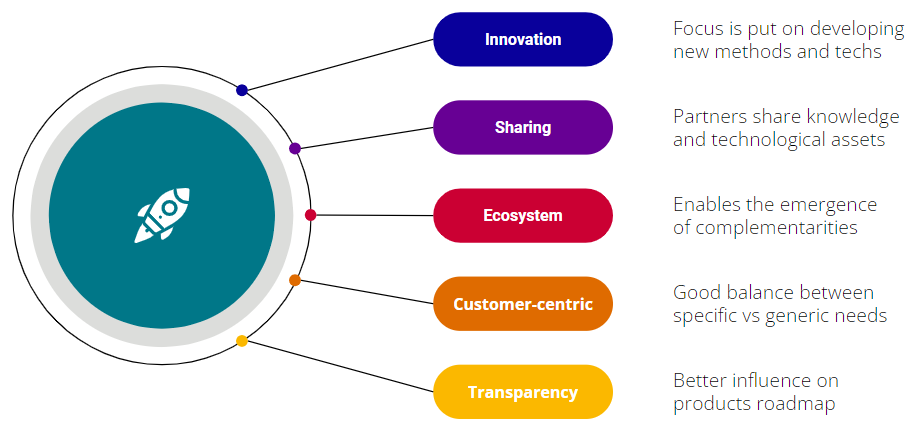
By sharing knowledge and resources, through open-source projects, we foster an environment that enables effective collaboration with our partners, balancing both specific and generic needs.

  • Collaborative Ecosystem: Partners share knowledge and assets for mutual benefit.
  • Innovative Product Development: a balanced approach that meets specific needs while fostering the emergence of innovation.
  • Better Roadmap Control: Organizations gain greater influence on future product developments.
Obeo - Open Innovation - Benefits

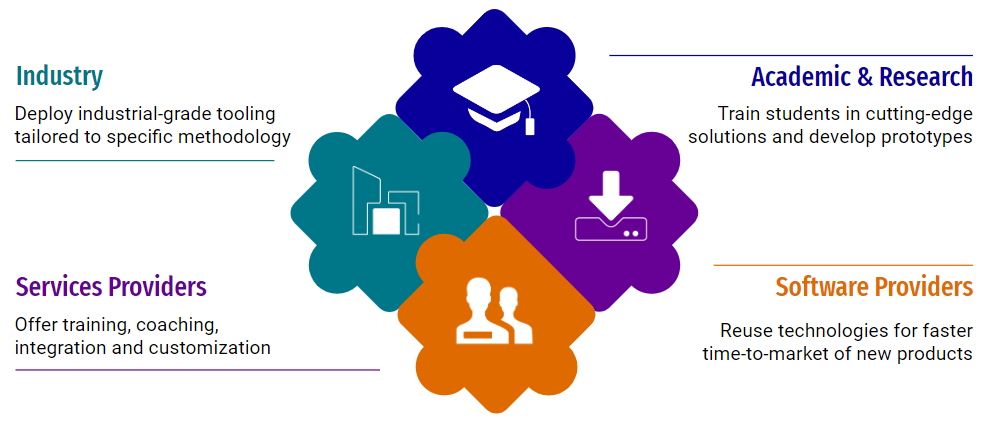
DIVERSITY OF ACTORS

Open Innovation brings together a diverse range of actors, including industrial playersservice providersacademicsresearchers, and software vendors, driven by different goals, yet collaborating together to drive technological advancements and foster innovation.

Obeo - Open Innovation - Actors

OPEN SOURCE

Open source is a catalyst for innovation. It plays a crucial role by lowering costs of robust and high-quality technologies, and fostering a sustainable, adaptable ecosystem:

  • Easier access to education, academia, and experimentation.
  • Mitigating vendor lock-in by simplifying the sharing of data and applications.
  • Enhanced sustainability and long term availability of the technology.
  • Enabling industrial collaboration, investments sharing and improved product roadmap influence.
  • Lowering the price for foundational capabilities.
  • Encouraging investments and competition on higher value capabilities.
  • Technological enabler for third-party addons fostering a rich ecosystem.

To achieve these benefits, collaboration under a vendor-neutral governance model is essential.

This is why Obeo is a strategic member of the Eclipse Foundation, a not-for-profit organization that supports and strengthens an independent, open, and transparent community to foster a sustainable ecosystem.

We are proud to count around twenty Eclipse committers (who can modify source code) and several project leaders for projects such as Sirius, SysON, Acceleo, and EMF Compare.

POSSIBLE RECEPTACLES

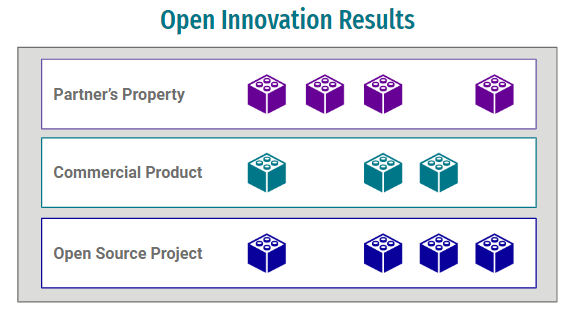
The outcome of an open-innovation project is typically a tailored, industrial-grade solution made up of dozens of technical components. These components are not necessarily contributed to open-source projects. They may end in different receptacles depending on the benefits for the community, as well as the objectives, challenges and constraints of the partners:

  • Open Source: the component is generic and aligns with an open-source project’s goals (such as fostering community collaboration, enhancing interoperability, or driving widespread adoption). It can be integrated into this open-source project, benefiting from other adopters’ feedback, and continuous improvements by its developers, alongside their regular releases.
  • Obeo’s Commercial Product (COTS): the component is generic and may interest other customers of a commercial product developed and distributed by Obeo, providing them with added value or advanced functionalities. It can be integrated into this product, benefiting from continuous improvements, alongside regular releases by its developers.
  • Partner’s Property: the source code is strategic for the partner, who does not want to share it, or it does not align with the goals of the open-source project or Obeo. It may remain the exclusive property of the partner, who then solely assumes the costs of maintenance and upgrades.
Obeo - Open Innovation - Receptacles

COLLABORATION MODE

At Obeo, each project developed through Open Innovation consists of three main phases:

  • Discovery: During this preliminary phase, which lasts about two weeks, we work with the client to develop a demonstrator of the solution. This allows us to validate our understanding of their needs, ensure the suitability of our technologies for the proposed solution, and assess the feasibility of the project. Together, we co-define a roadmap for the next steps.
  • Development: Throughout a series of two-week iterations, we develop the solution with our client. Each iteration, carried out in an agile mode, produces components that can either be generic and contribute to open-source projects, or entirely specific and potentially integrated with components developed directly by the client.
  • Maintenance: Once the project is completed and delivered, it enters a maintenance phase during which the client can subscribe to an annual plan that covers generic components (Software Assurance) and/or specific components (Maintenance Agreement).

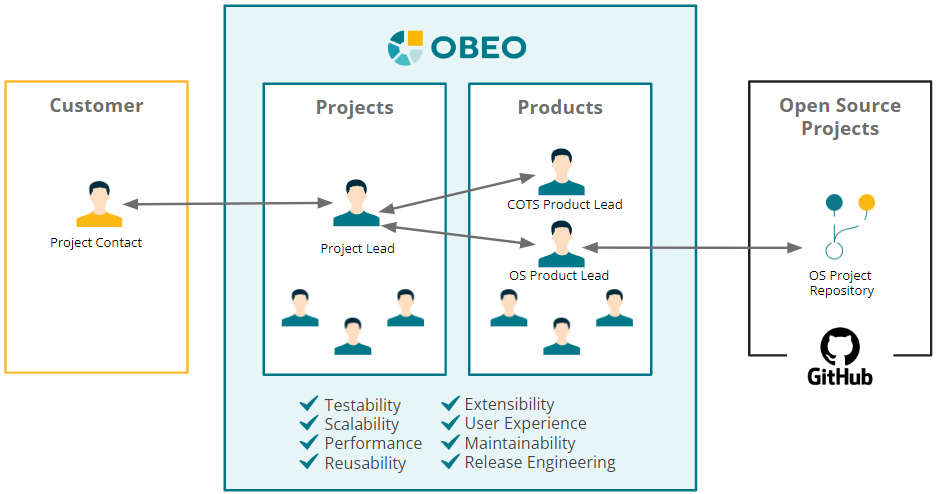
The Open innovation project is overseen by a dedicated Project Lead. As a member of the Projects team, he is responsible for managing the project on behalf of Obeo, serving as the main point of contact for the client, and ensuring that both client requirements and Obeo’s commitments are fully met.

The Project Lead directly manages a team of technical experts involved in the project and fosters seamless collaboration with the leads of the products that will incorporate some of the open innovation project’s outcomes. This ensures that developments are smoothly integrated at the optimal level and benefit from the highest level of technical expertise.

Throughout the project, our teams focus on key concerns that define all our software: testability, scalability, performance, reusability, extensibility, user experience, and maintainability, all within an industrialized release-engineering process.

Obeo - Open Innovation - Project

Let’s work together to turn your needs into reality!